
Imagine this: It’s Tuesday morning. You’re sipping coffee, ready to start your workday, when your car refuses to start. Or worse, your boss calls you into a meeting and hands you a severance package.
Panic usually sets in at this moment. But for a select group of people, the panic is replaced by a mild annoyance. The difference? They have a fully funded emergency fund.
In the world of personal finance, advice is often thrown around loosely: “Save $1,000!” or “You need 6 months of expenses!” But generic advice often leads to generic results. The truth is, the amount of cash you need isn’t a static number—it’s a dynamic calculation based on your unique life circumstances.
If you are ready to stop losing sleep over “what-ifs” and build a fortress around your finances, this guide goes beyond the basics to help you calculate your real number.
The Psychology of the “Stash”
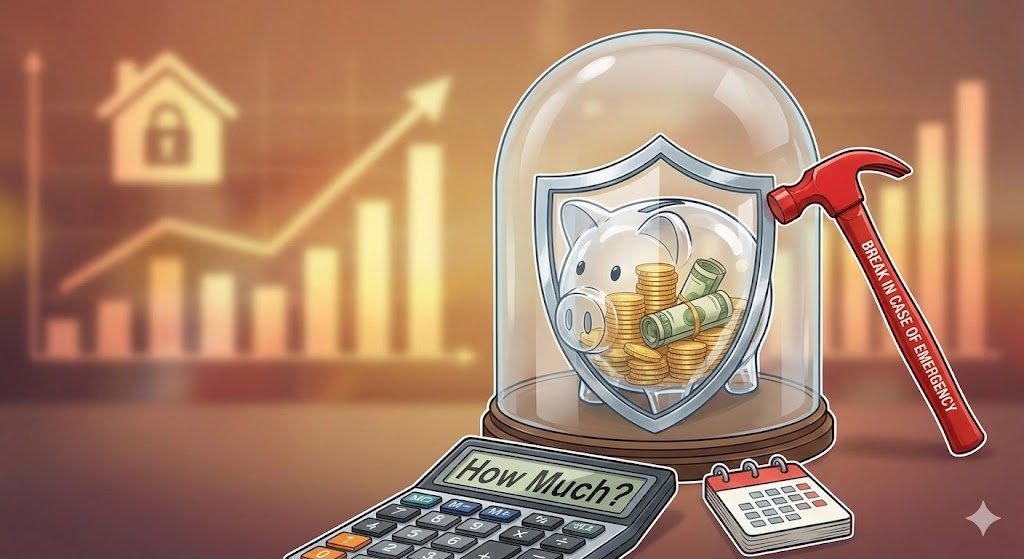
Before we do the math, we have to talk about the mindset. An emergency fund isn’t just a pile of cash sitting in a bank account losing value to inflation (we’ll talk about how to fix that later). It is financial insurance.
When you don’t have savings, every minor bump in the road—a flat tire, a dental cavity, a leaky roof—becomes a crisis. You are forced to rely on high-interest credit cards, which pulls you deeper into the debt cycle.
Key Insight: Money is emotional. The goal of an emergency fund isn’t to make you rich; it’s to prevent you from becoming poor when life happens.
The “Rule of Thumb” vs. Your Reality
Standard finance articles will tell you to save 3 to 6 months of expenses. While this is a good starting point, it is dangerously vague for many people.
A tenured professor with a paid-off mortgage needs a very different safety net than a freelance graphic designer living in a high-cost city.
The “Sleep Well at Night” Calculator
To find your specific number, you need to assess two main factors: Income Stability and Financial Dependents.
| If you are… | Recommended Fund Size | Why? |
| Dual-Income Household (Stable jobs, no kids) | 3 Months | If one loses a job, the other salary keeps the lights on. Risk is shared. |
| Single Income (Stable job, renters) | 6 Months | You are the sole provider. If income stops, bills pile up immediately. |
| Freelancer / Commission Based | 6 – 9 Months | Income fluctuates. You need a buffer for “lean months” plus emergencies. |
| High-Risk Industry / Dependents | 12 Months | If you have children or work in a volatile tech startup, cash is king. |
Step 1: Calculate Your “Bare Bones” Budget
One of the biggest mistakes people make is calculating their emergency fund based on their current spending. You do not need to replace your vacation fund or your dining-out budget during an emergency.
You need to calculate your Survival Number.
Sit down with your bank statements and add up only the non-negotiables:
- Housing: Rent or Mortgage (plus property taxes/insurance).
- Utilities: Electricity, water, heat, internet (yes, internet is essential for job hunting).
- Food: Groceries only (no restaurants).
- Transportation: Gas and insurance.
- Minimum Debt Payments: Credit cards or loans to keep your credit score intact.
- Insurance: Health and Life premiums.
The Math: If your survival number is $3,000/month and you are a freelancer (aiming for 9 months), your target is $27,000.
Step 2: Where to Keep the Money (Liquidity vs. Growth)
This is where advanced personal finance strategies come into play. You should not keep $20,000 in a standard checking account earning 0.01% interest. That is literally throwing money away.
However, you also cannot lock it up in the stock market or real estate, because you need it to be liquid (accessible instantly without penalty).
The Solution: High-Yield Savings Accounts (HYSA)
A High-Yield Savings Account is the gold standard for emergency funds.
- It’s Liquid: You can transfer money to your checking account in 1-2 days.
- It Fights Inflation: As of 2024/2025, many HYSAs offer 4% to 5% APY.
- It’s Separate: “Out of sight, out of mind.” If the money is not in your main checking account, you are less likely to spend it on impulse buys.
Pro Tip: Look for banks like Ally, Marcus, or SoFi. CheckBankratefor the current highest rates. Ensure the bank is FDIC insured.
Step 3: The “Tiered” Emergency Fund Strategy
If holding $30,000 in cash feels painful because you want to be investing, consider a Tiered Strategy. This is popular among those heavily interested in optimizing their finance portfolio.
Tier 1: The First Responder (Cash)
- Amount: $1,000 – $2,000.
- Location: Checking account buffer or physical cash in a safe.
- Use: Tow trucks, immediate repairs, cash-only situations.
Tier 2: The Bulk (HYSA)
- Amount: 3-4 months of expenses.
- Location: High-Yield Savings Account.
- Use: Job loss, major medical bills.
Tier 3: The “Break Glass” (Conservative Investments)
- Amount: The remaining 3-6 months.
- Location: Taxable brokerage account (invested in low-volatility bonds or money market funds).
- Use: Long-term unemployment (6+ months).
How to Build the Fund (Without Starving)
Staring at a goal of $15,000 can feel paralyzing. The secret is to reverse-engineer the goal.
- Start Small: Aim for $1,000 first. This covers 90% of minor emergencies (brakes, vet bills, appliance repair).
- The “Found Money” Rule: Did you get a tax refund? A birthday check? A work bonus? A seemingly small $50 rebate? Transfer 100% of “found money” directly to the fund. Do not let it touch your checking account.
- Audit Your Subscriptions: Cancel the streaming services you haven’t watched in a month. It sounds cliché, but $50/month saved is $600 a year toward your safety net.
![Chart showing the growth of saving $200 a month with compound interest]
(Use Elementor’s Progress Bar widget here to visualize a savings goal!)
Conclusion: Buying Your Freedom
Ultimately, personal finance is personal. Your emergency fund number might differ from your neighbor’s, and that is okay.
Having this cash reserve changes your demeanor. When you have 6 months of expenses in the bank, you don’t have to tolerate a toxic boss because you’re terrified of missing a paycheck. You don’t have to spiral into debt because the furnace broke.
Money is a tool, and an emergency fund is the most important tool in the box. It buys you time, options, and peace of mind.
What is your “Sleep Well at Night” number?
Start calculating today. If you have questions about which High-Yield Savings Accounts are best right now, or how to balance paying off debt while saving, drop a comment below!
Disclaimer: I am not a financial advisor. This content is for educational purposes only. Please consult a qualified professional before making major financial decisions.